Turkey’s largest independent business organization, Turkish Business Confederation, which brings together members on a voluntary basis, held the 26th Business Summit in Antalya. Speaking at the opening of the summit, held under the theme “Turkey in a Period of Global Disruption,” Turkish Business Confederation President Süleyman Sönmez said: “We are trapped in a vicious cycle of ‘low added value, low income, and low productivity.’ In industry, we produce, but the profit is credited to someone else. We need to launch an aggressive high-tech initiative and a nationalization drive in intermediate goods production.”
Turkish Business Confederation President Süleyman Sönmez: "In industry, we produce, but the profit goes to someone else's account."
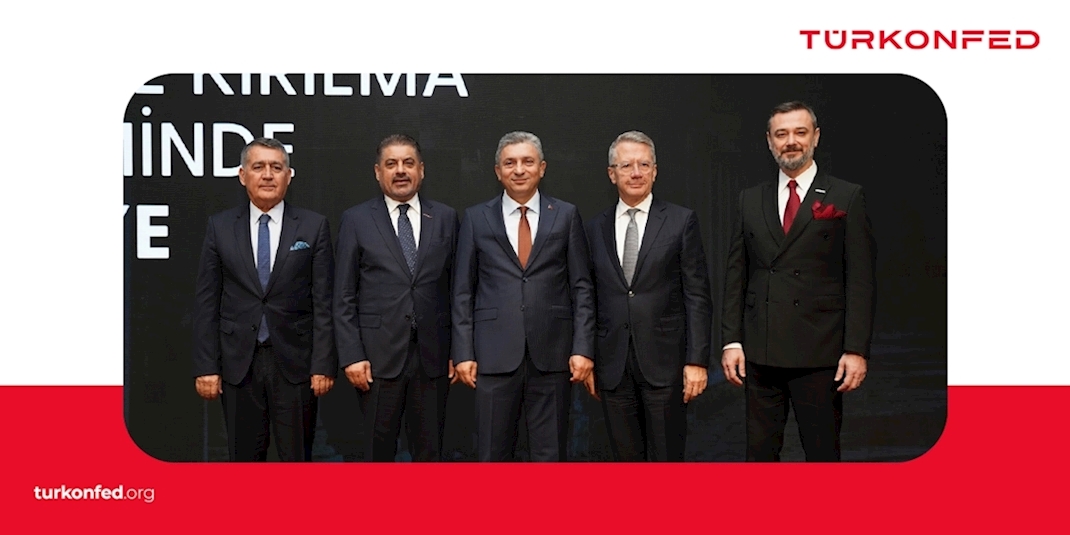
The Turkish Business Confederation , which encompasses 31 federations and 340 national and international member associations representing over 100,000 companies, organized the 26th Business Summit under the theme “Turkey in a Period of Global Disruption.” Hosted by the Western Mediterranean Industry and Business Federation (BAKSIFED) in Antalya, the summit was attended by over 500 businesspeople and representatives of civil society organizations from across Turkey, as well as public officials including Antalya Governor Hulusi Şahin.
Süleyman Sönmez: “$20,000 per capita does not make us a prosperous country”
Speaking at the opening of the summit, Turkish Business Confederation President Süleyman Sönmez drew attention to the structural problems of the Turkish economy in this period of global disruption. Noting that Turkey fell 13 places compared to the previous year to 66th out of 69 countries on the 2025 World Competitiveness Index published by the International Institute for Management Development (IMD), Sönmez said: “We are trapped in a vicious cycle of ‘low added value, low income, and low productivity.’ Istanbul’s income is four times higher than that of Van-Bitlis-Muş; its production and financial weight is even twice that of Ankara, which ranks second. These massive disparities are unsustainable both economically and socially. Meanwhile, the productivity rate of our large companies is only half the EU average; in SMEs, it falls to one-fifth. Even if we reach the per capita target of $20,000 set for 2028 in the Medium-Term Program, we cannot become a prosperous country without addressing our structural problems.”
“We must launch a high-tech initiative and a nationalization drive in intermediate goods production”
Highlighting that the foreign trade deficit is essentially a technology gap, Sönmez stated: “Even though some sectors stumble today, we are leaders in our region in automotive, white goods, and defense industries, and we derive a quarter of our national income from industry. However, while the share of high-tech exports in China, with which we compete on price, has reached 30%, in Turkey this ratio remains around 3–4%. In industry, we produce, but the profit is credited to someone else. We sell industrial raw materials, and our business partners in export markets add innovation, design, and branding on top of that, earning many times more for their national income than we do. We need to increase our R&D spending from 1.5% to 3.5% and launch an aggressive high-tech initiative and a nationalization drive in intermediate goods production.”
Sönmez outlined his solutions as follows: “We must transform exports from the success of a few companies in certain sectors into a nationwide development journey. We should establish R&D and innovation centers that all companies can use, and also advocate for their establishment. We must foster a culture of learning from one another and of ‘competitive collaboration.’ Through the Turkish diaspora, we need to build stronger connections with technology hubs such as Silicon Valley, Berlin, Singapore, and Dubai.”
“First the law, then trust in each other”
Sönmez emphasized that trust in the economy is cautiously improving and said: “As we enter 2026, we are still far from where we need to be. Therefore, even if nominal growth continues in the new year, we anticipate a year of real balance. By late 2026, we expect to see the first signs of objective improvement in financial stability. If we can combine financial stability with regional development and production through green and digital transformation, we can become one of the countries shaping the ongoing restructuring period. However, the most crucial elements of this success story are judicial independence, trust in institutions, and faith in democracy. Without trust and transparency, neither economic growth nor future-building is possible. If we want sustainability in growth, we must first trust the law and then each other.”
Orhan Turan: “If we read global changes correctly, we can benefit from this process”
TÜSİAD Chairman Orhan Turan emphasized the rapid and interconnected changes in the world, stating: “We must closely monitor these changes. In recent international visits, I have observed this very closely. While we manage short-term shocks, we must not overlook the long-term evolution of the global system. We are in a period where geopolitical balances, the global economic system, technology, climate, and even societies are rapidly changing, uncertainty and risk are high, and yet for those who adapt timely, great opportunities exist. We must manage short-term challenges without abandoning long-term goals. The long-accepted business models must be fundamentally changed, and we must prepare ourselves, our companies, our cities, and our country. If we read global changes correctly and take timely measures, we will emerge successful.”
TÜSİAD High Advisory Council Chairman Ömer Aras, speaking as a guest, said: “As TÜSİAD, we have undertaken a study that contributes to our exports and fills an important data gap in Turkey. We created the TÜSİAD Cost-Based Competitiveness Index, which shows how our cost-based competitiveness dynamics change over time compared to competitor countries. We need to assess global competitiveness conditions accurately, particularly with data, to generate solutions. To increase competitiveness, we must work together. Building a stronger, more competitive economy starts with proper education. Today, one of the biggest complaints after finance is finding and retaining qualified human resources. As a country, we must invest in quality education and integrate underutilized young people and women into the workforce. We must create an economy that exports competitive goods and services based on productivity, focusing on technology and innovation-driven production. Companies should also take steps to increase productivity and competitiveness. Together with macro-level measures, these actions will help create a more competitive, productive, and export-driven economy.”
Mustafa Cengiz: “Those who avoid risk will lose”
Western Mediterranean Industry and Business Federation (BAKSIFED) Chairman Mustafa Cengiz, host of the 26th Business Summit, pointed out that many companies in Turkey adopt a “wait for the crisis to pass, then invest” mentality. He said: “Companies that continue with five-year-old business models, see digital transformation as a cost, fear innovation, and avoid taking risks will not only lose markets but likely disappear entirely. No company or country in the world is waiting for this transformation to end; on the contrary, they are building the new economy amidst the crisis. We also have great potential. Turkey could become Europe’s technology production hub, the Middle East’s financial center, Eurasia’s logistics nervous system, and the Mediterranean’s green energy leader. We have the necessary human resources, geographic advantage, entrepreneurial spirit, and production capacity. What is missing are long-term strategy, transparency, predictability, and bold actions. As the business world, we must address these gaps.”
Koton, Migros, and Vodafone Turkey executives panel discussion
As part of the program, a panel with the same name as the summit was held. Moderated by TÜRKONFED Economic Advisor Can Selçuki, the panel included Koton CEO Dr. Bülent Sabuncu, Migros Executive Board Chairman Ömer Özgür Tort, and Vodafone Turkey Deputy CEO Özlem Kestioğlu. During the ‘TÜRKONFED Trade Bridge 2.0’ segment of the summit, AI-supported B2B meetings took place. The summit also shared TÜRKONFED’s local-to-international initiatives, and the confederation’s affiliated commissions presented their 2025 work plans and new-term objectives.